BaGet
BaGet Extension
BaGet Extension is A NuGet, Maven, NVM, Docker and symbol server. It is open source (a fork of loic-sharma/BaGet), cross-platform, and cloud ready!
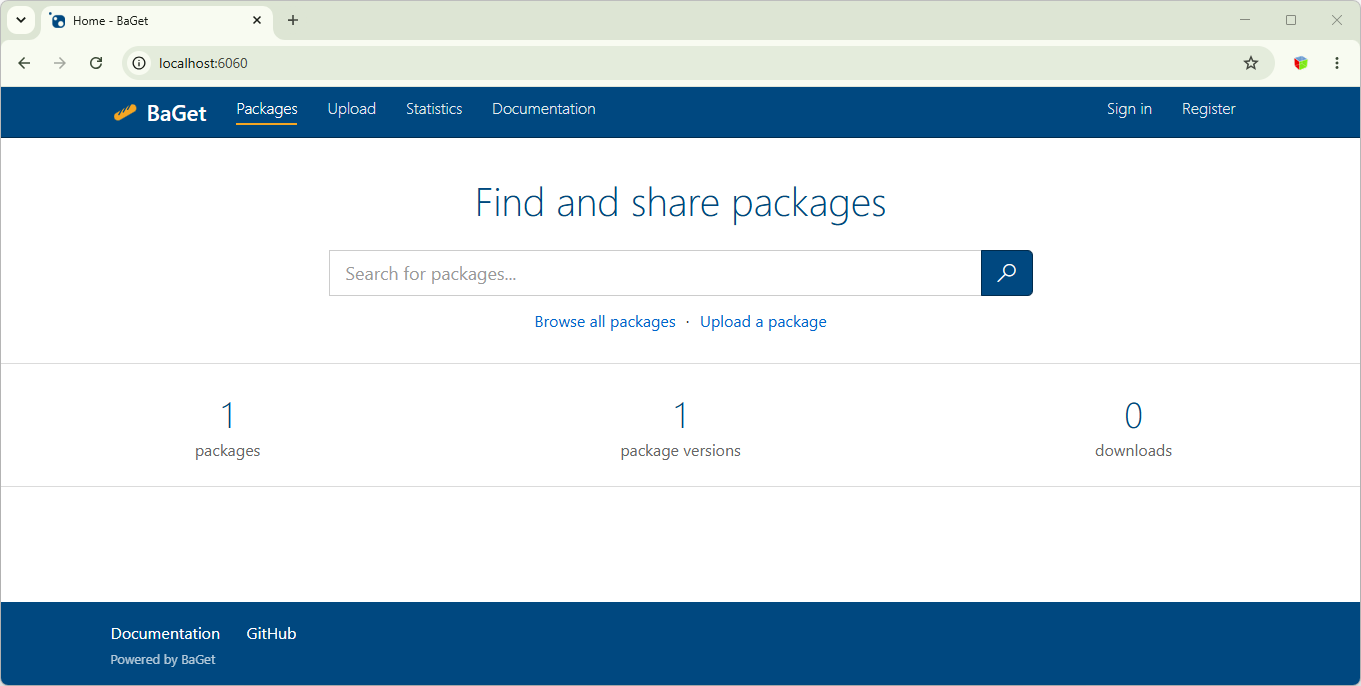
New here? Read the installation manual and the user manual; operators: the DevOps manual; common tasks: how-to.
Run BaGet Extension
You can run BaGet Extension on your preferred platform:
A fresh install has one account, the default administrator Admin / Admin1234!: sign in and change its password at once.
Repositories
One server can hold several repositories, each with its own feed at /r/{name}/v3/index.json; default stays at /. Repositories have a format: NuGet, and npm registries (npm publish / install, dist-tags, deprecate, unpublish, npm login), Maven repositories (mvn deploy, snapshots, checksums, release/snapshot policy) and a Docker registry (docker login / push / pull, multi-platform images, referrers). A remote repository caches another NuGet feed, npm registry, Maven repository or Docker registry such as registry.npmjs.org or Docker Hub (credentials, cache periods, offline mode, purge); a virtual repository puts several of them behind one URL (first match wins, merged search and packuments, uploads to a chosen member). Retention policies delete old versions on a schedule (keep the newest N, by age, unused, remote cache size, untagged Docker manifests) with a dry run and legal holds. Replication copies a local repository to or from a repository of another BaGet server (push or pull, on deploy and on a schedule, resumable, any format). High availability runs several nodes behind a load balancer on one database, object store and Redis (jobs run once, the read-only gate and rate limits are shared, /health/live and /health/ready). The Settings page edits configuration live, and OpenTelemetry export (traces, metrics, logs) needs an OTLP endpoint.
Access control
Who may read and write what is set by groups, permission targets and project roles: private feeds, Basic-auth client setup, upgrade defaults and the admin pages.
Vulnerability scanning
Packages, npm and Maven artifacts are checked against OSV.dev (online or an offline copy) and Docker images by
Trivy; findings appear on every package page and in an administrator dashboard, feed NuGet’s vulnerability resource, and a
per-repository or per-project policy can warn or refuse downloads and deploys with 403 and the reason:
vulnerability scanning.
Administration REST API
/api/v1 does everything the administrator pages do (repositories, access model, users, operations, retention, scanning, replication) for
scripts, with an administrator’s API key and OpenAPI 3: administration REST API; try every endpoint in the browser: testing the APIs with Scalar. Every web screen also has a JSON twin for custom frontends: UI API; build your own in React or Angular: custom frontend.
What BaGet Extension serves
BaGet Extension speaks the NuGet V3 protocol, with a V2 feed for older clients (on by default), and serves
symbols; npm, Maven and Docker are served per repository (above). Accounts with package owners and per-user API keys are on by default; a validation
pipeline with repository signing is opt-in. Both are set in its configuration.
By default it listens on http://localhost:6060 (Kestrel:Endpoints; --urls has no effect). The server API lists
every resource and page, UI coverage maps every capability to its page, and BaGet Extension vs nuget.org compares the two.
Import packages
Compare BaGet Extension
Advanced
BaGet Extension SDK
You can also use the BaGet.Protocol package to interact with a NuGet server. For more information, please refer to the BaGet Extension SDK guide.
To browse these pages without a site, see reading this folder.
Credits
BaGet Extension is based on BaGet (pronounced “baguette”) by Loic Sharma, released under the MIT licence. See LICENSE and Acknowledgments.